
What is a cooling ceiling?
The essential compendium on modern climate ceilings: functionality, extreme advantages in practice, and why they are increasingly replacing air conditioning systems.
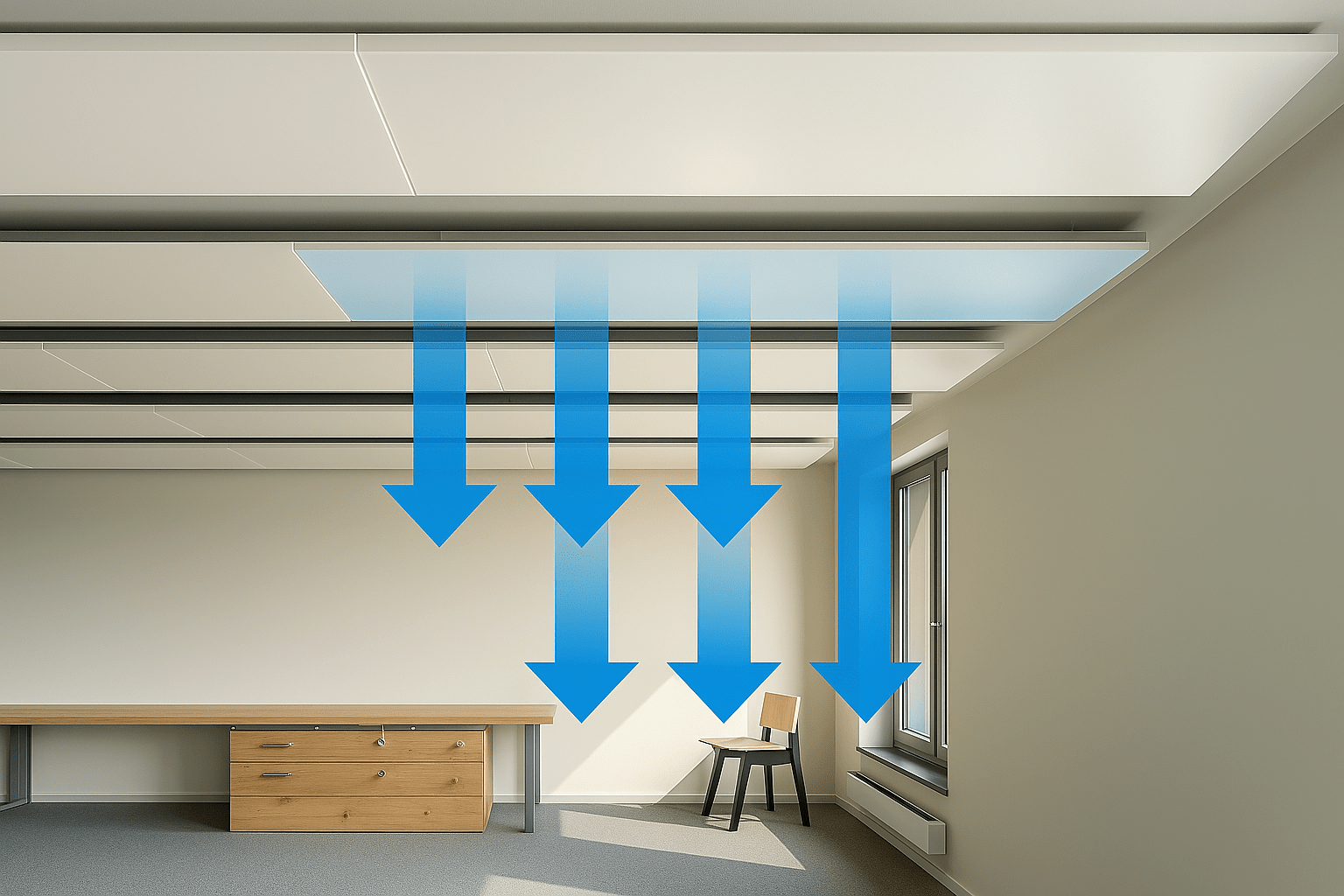
How does a cooling ceiling work?
Unlike classic air conditioning, the principle of surface cooling is not based on ice-cold, moving air, but on the highly natural physical principle of radiant exchange.
Chilled water circulates continuously through fine-mesh capillary tube networks, copper pipes, or plastic registers applied directly to the back of a ceiling panel (e.g., in a seamless gypsum board cooling ceiling or in free-hanging metal ceiling sails). This lowers the surface temperature of the ceiling to a constant, pleasant level (often between 16°C and 18°C).
Since heat in physics always strives to move to cooler zones, warm surfaces in the room - like people, window surfaces, furniture, or technical devices - transfer their excess thermal energy in the form of long-wave infrared radiation to this cooler ceiling surface. You can imagine the effect similarly to being in a natural stone vault on a hot summer day: The room feels fresh without feeling a breath of air.
This heat exchange takes place completely silently and without noticeable air movement (i.e., without the dreaded draft). The result is a gentle and absolutely even cooling of the entire room, which is perceived by the human organism as much more comfortable than convective cooling by fan coils or split units. In winter, the system is operated reversibly: Warm supply water flows through the same pipe network, and the cooling ceiling transforms into a large-area radiant ceiling heater that emits pleasant heat from above - like underfloor heating, only on the ceiling.
The advantages at a glance
Why silent surface cooling is replacing conventional air conditioning systems in modern architecture.
Highest Comfort
No drafts and no disturbing noises. Cooling takes place through gentle radiation, which is perceived as particularly pleasant.
Energy Efficient
Cooling ceilings are very economical and work ideally in combination with renewable energies like heat pumps, minimizing operating costs.
Silent Operation
Since no blowers or fans are needed, cooling ceilings are absolutely silent and create a concentration-enhancing environment.
Hygienic & Healthy
By eliminating air circulation, there is no swirling of dust, viruses, or bacteria – ideal for sensitive environments.
Room Aesthetics & Acoustics
The entire technology is integrated invisibly into the ceiling. At the same time, the perforated ceiling surface acts as a highly effective sound absorber.
Low Maintenance & Durable
The systems work completely without filter changes, refrigerants, or moving parts, reducing maintenance effort to a minimum.
Typical areas of application
Because cooling ceilings provide peak thermal performance without the negative side effects of air systems, they are now the standard in premium real estate.
- ✓ Office buildings for New Work: Promotes concentration in open-space offices and absorbs reverberation (improved room acoustics).
- ✓ Hospitals & Clinics: Since no bacteria are swirled up by drafts in the hospital room, hygiene standards are optimally maintained.
- ✓ Premium Hotels: Creates the highest undisturbed guest comfort for a night's rest, without a loud, pulsating blower above the hotel bed.
- ✓ Schools and Universities: Creates an optimal learning environment with simultaneous integration of LED lighting.
- ✓ Architectural Residential Construction: Enables a clean ceiling design without ugly air outlet grilles in the penthouse or loft.
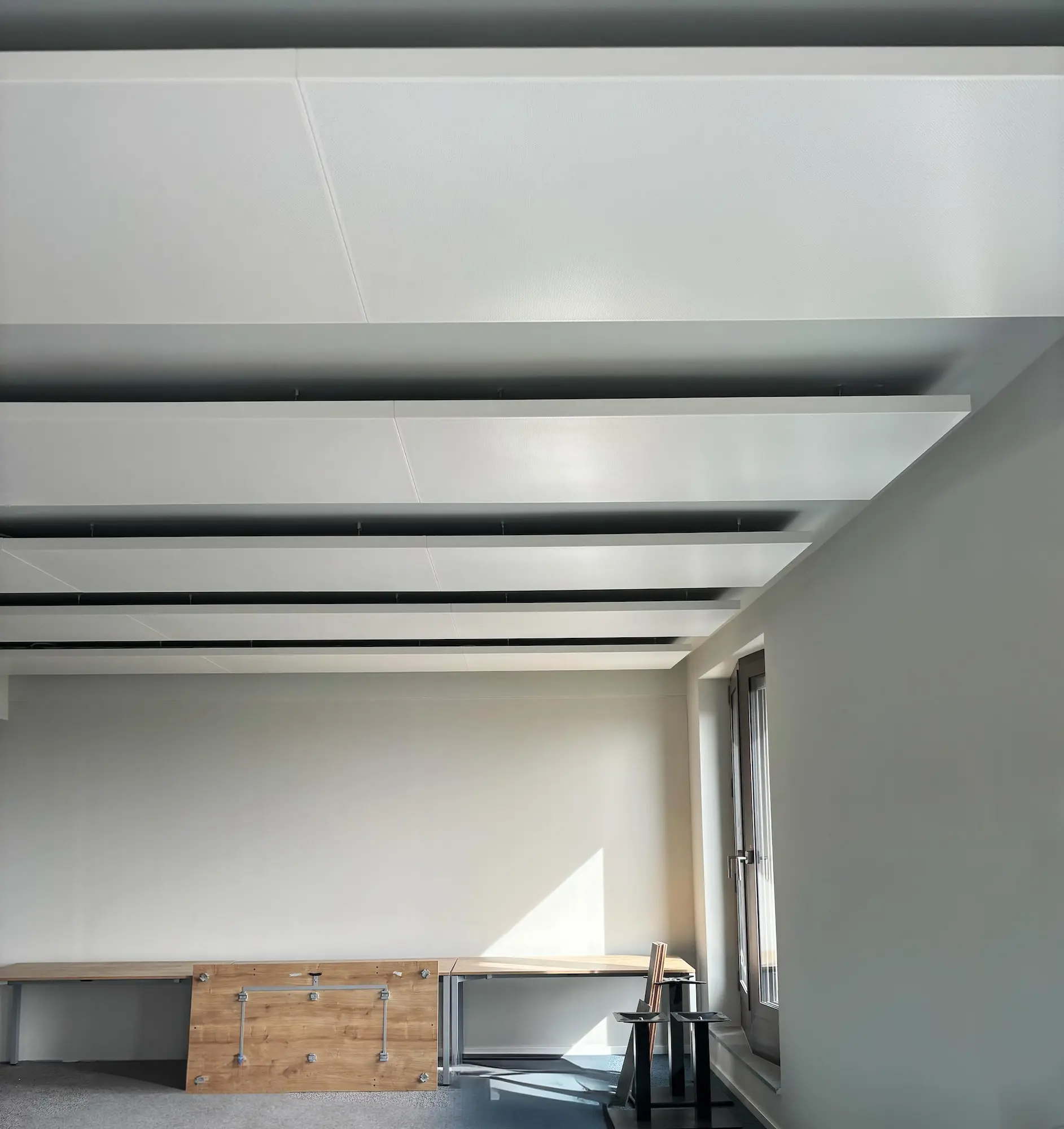
What is the cooling capacity of surface cooling?
A decisive criterion in HVAC specialist planning is the specific cooling capacity (measured in watts per square meter of active area) that a ceiling can emit into the room. This depends heavily on the design, the material of the ceiling, and the pipe spacing of the cooling registers.
Closed, seamless systems like the classic gypsum board cooling ceiling usually achieve capacities between 70 and 90 W/m², tested according to DIN EN 14240. Closed cassette ceilings made of powder-coated metal can often achieve slightly higher transfer rates.
Free-hanging cooling ceiling sails made of high-performance aluminum or metal, on the other hand, do not operate as a closed surface. As a result, the sail benefits from the ambient air from both sides (ceiling and room side) and generates an increased convective share in addition to radiant exchange. Here, peak cooling capacities of 110 to 140 W/m² are achievable.
For modern office complexes with large glass facades or high internal heat loads (numerous computers, servers, dense personnel occupancy), an exact rough design is enormously important to ensure that the sum of the ceiling area can confidently dissipate the peak cooling load in summer.
Dew point monitoring and condensation prevention
One of the most frequently asked questions by builders regarding cooling and heating ceilings is: "Can the ceiling start to drip?"
There is an extremely reliable technical solution for this: dew point monitoring. Condensation (i.e., the formation of water droplets on a surface, similar to a cold soda can in summer) only occurs when an object is colder than the physical dew point of the ambient air humidity in that room.
Since classic surface cooling systems operate with supply temperatures around 16°C (i.e., relatively moderate cold water temperatures compared to split units that are cooled down to 6°C), you are already close to the room temperature anyway. To guarantee absolute safety against condensation, intelligent, electronic dew point sensors – often discreetly clipped onto the cooling registers themselves or invisibly to the distributor of the water-bearing network – are installed.
These sensors constantly measure the temperature in real-time in correlation to the relative room air humidity. If the ceiling temperature approaches this critical dew point (usually with a safety buffer of about 1.5 to 2 Kelvin), the smart individual room control intervenes. It either mixes the cold supply water warmer or temporarily blocks the inflow into this room via an actuator. As a result, a modern, professionally planned room climate ceiling can under no circumstances ever start to condense or drip.
The perfect symbiosis: Combination with ventilation systems
Surface cooling systems cool the temperature. However, they do not care about the air quality - the CO2 content - in heavily occupied rooms. But since a minimum hygienic air exchange for fresh air is urgently required, especially in modern, well-sealed commercial buildings, a combination of both worlds is the absolute premium solution in modern plant construction.
The enormous strength of the cooling ceiling is the decoupling of thermal load (temperature development) and the air exchange (fresh air requirement).
In buildings of conventional design, huge, energy-guzzling HVAC systems usually do both: they have to cool massive amounts of air and press it through deep, wide ducts into the rooms. However, if a cooling ceiling silently absorbs almost 100% of the summer heat base load, the conventional HVAC system can focus exclusively on the fresh air supply.
For investors and architects, this means: The duct systems for central ventilation can be dimensioned dramatically smaller and more cost-effectively. You save an enormous amount of space in the ceiling area for other trades (like grid sprinkler systems or lighting ducts). Many Estrics customers opt for smart hybrid sails here, in which invisible supply air distributors are directly integrated, so that the ceiling system highly efficiently directs both fresh air and cooling to the workplace.
Costs and life cycle: An economic quantum leap
HVAC planners and investors rarely calculate only with the initial installation costs (Capex). Much more decisive in real estate valuation are the operating and maintenance costs over the next 30 years (Opex).
A surface system has no fans, no filters, no condensate water drains that could calcify in the ceiling area, and does not wear out. Water is also an approx. 4,000 times more efficient energy carrier than air, which is why the pump energy for the building system is minimal. The savings on maintenance contracts and electricity bills are enormous and immensely improve the ESG criteria of any building portfolio.
Checklist for HVAC planners
Condensation Prevention
Precise control with dew point monitoring is crucial to keep the ceiling's surface temperature safely above the dew point of the room air, thus preventing condensation.
Ceiling System & Load Bearing
The weight of the cooling ceiling system (incl. water-filled registers) must be considered in the structural planning of the substructure and ceiling suspension.
Hydraulic Design
Correct hydraulic planning via Tichelmann distributors ensures that all areas have an even flow, guaranteeing homogeneous cooling and heating performance.
Integration of System Components
The thermal connection to the central heating and cooling system, especially to modern heat pumps or geothermal systems, must be carefully planned.
Plan your next project.
Whether new construction or energy renovation. We configure your tailor-made climate ceiling system.