
Cooling ceiling or air conditioning in the office?
A ruthless comparison of the two systems for modern working environments. Find out which solution offers more comfort, health, and efficiency.
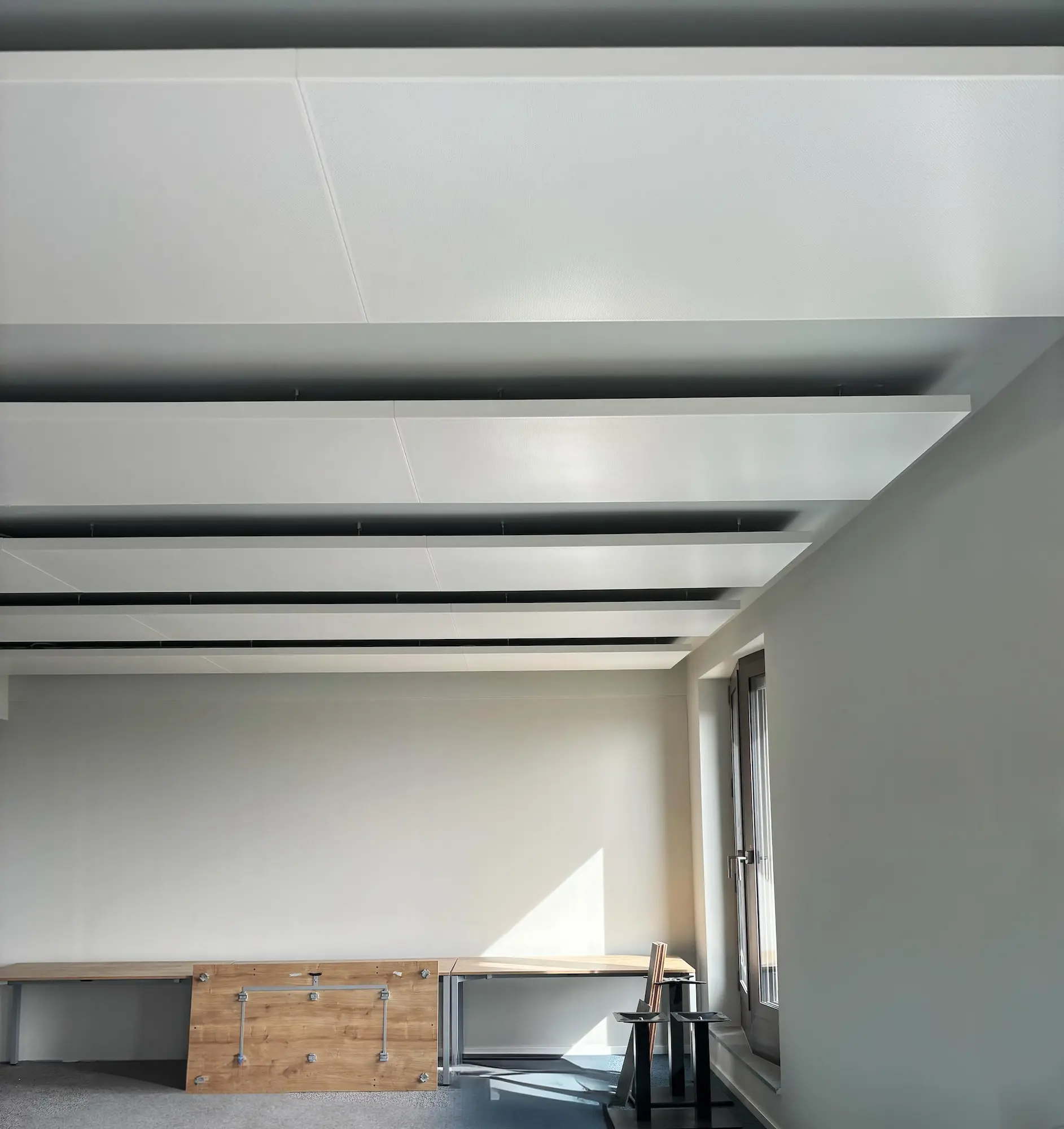
The eternal duel in the modern office
At the latest when planning large, glazed open-space offices, investors and specialist planners are faced with the ultimate question: How do we get the enormous internal heat loads (servers, people, monitors, solar radiation) out of the room in summer?
For decades, the classic air conditioning system (e.g., as a split unit or central fan coil system) was the unwritten standard. But with the shift towards "New Work", coupled with the increasingly strict energetic building standards, a technological changing of the guard has taken place: The cooling ceiling.
To be able to objectively assess whether an air conditioning system or a cooling ceiling is better for the office, you have to understand that both systems achieve the same purpose in completely different ways. While the air conditioning system uses ice-cold, dry air as a transport medium (convection), the cooling ceiling extracts the heat from the room almost magically completely silently via invisible radiant exchange, just like a cool cave on a summer day.
Direct comparison: The hard facts
| Criterion | Climate Ceiling / Surface Cooling | Classic Air Conditioning (Air) |
|---|---|---|
Thermal Comfort | Very high: Silent and even cooling through gentle radiant exchange. No noticeable draft. | Low to medium: Cooling through ice-cold air injection. Often noticeable drafts and cold spots. |
Acoustics & Noise Level | Excellent: Absolutely silent operation (0 dB in the room). Acoustic cooling ceiling sails additionally absorb reverberation. | Poor: Permanent, disturbing operating noises from indoor units (fans) and compressors. |
Energy & Operating Costs | Very high: Uses high supply temperatures (16-18°C), works minimally invasively. Ideal for heat pumps. Up to 35% savings. | Medium: Requires low refrigerant temperatures (6-8°C), requires a huge amount of pump electricity for fans. |
Hygiene & Health | Very high: No air circulation. Viruses, bacteria, and house dust are not swirled up (Sick Building Syndrome). | Problematic: Dries out the mucous membranes. Built-in filters are often breeding grounds for germs that are distributed in the room. |
Architecture & Design | Maximum freedom: Technology disappears invisibly into the seamless ceiling or is staged as a floating design ceiling sail. | Medium: Large technology cassettes, visible wall units, or floor outlets often disrupt the room design. |
Maintenance Effort | Minimal: A self-contained system without moving parts or filters. Extremely long service life. | High: Strict hygiene regulations require quarterly or annual filter changes and refrigerant checks. |
Investment Costs (Capex) | Initially slightly more expensive than simple split units. However, it pays for itself extremely quickly due to eliminated OPEX costs. | Lower initial investment, which is put into perspective by astronomical electricity, maintenance, and servicing costs within 5 years. |
The Health Dilemma: Sick Building Syndrome
One of the primary reasons why large corporations are moving away from air conditioning in office buildings is employee health. The typical office air conditioning system blows air with temperatures of only 14°C to 16°C into the room. This inevitably leads to noticeable drafts, tense neck muscles, and a constantly dried-out room climate that strains the mucous membranes of the employees.
In addition, the fans of the split units distribute the accumulated house dust, allergens, and, in the case of poor maintenance, bacteria from the condensation network across the room (Sick Building Syndrome). Surface cooling, on the other hand, operates entirely without air turbulence. It only lowers the wall and ceiling surface temperatures and leaves the breathing air completely in peace.
Scientifically proven
Numerous building physics studies prove the superior physiological comfort of radiant cooling. The elimination of cold drafts and the avoidance of particle turbulence drastically reduce room climate-related complaints.
Acoustics: The ultimate room quietness
Mental work requires silence. Anyone who has to sit focused at a computer for 8 hours or make phone calls relies on a quiet working environment. Air conditioning systems, however, inevitably cause noise because powerful fans have to press the air through narrow slats. The sound pressure level of conventional ceiling cassettes is usually between 25 and 40 dB(A). What initially sounds like a "quiet whisper" creates stress after hours.
A cooling ceiling, on the other hand, is 100% silent (0 dB). The water flowing in it (just as much as in underfloor heating) causes minimal to no flow noises.
But it can do even more: In open-space offices, the noise from phone calls and typing colleagues echoes. Cooling ceiling sails made of metal can be micro-perforated and backed with acoustic fleece. As a result, they mutate into a highly effective broadband absorber that swallows the dreaded reverberation in the office and raises speech intelligibility to an absolute top level. A double win for modern working environments.
Sustainability and the Heat Pump Symbiosis
To counteract global CO2 change, modern office buildings are increasingly equipped with geothermal or air-water heat pumps. And on this topic, the cooling ceiling wins the system duel absolutely overwhelmingly.
An air conditioning system requires so-called cold water or refrigerant for the process, which often has to be cooled down to 6°C (which consumes a massive amount of electricity). Thanks to its huge active surface (the entire ceiling), a climate ceiling only requires gently tempered supply water of 16°C to 18°C. This moderate pre-cooling requires a fraction of the compressor electricity. Some systems even cool "passively" (free cooling) in summer simply by using groundwater or deep geothermal probes, completely free of charge.
Added to this are the maintenance costs: A closed water pipe network in the ceiling cavity does not wear out. There are no mold-forming condensate trays, no expensive HEPA filters that have to be replaced quarterly. The Total Cost of Ownership (TCO) of a cooling ceiling beats almost every air system on the market in the first 10 business years.
The final conclusion
The classic air conditioning system has its place: in server rooms, for rapid emergency cooling, or for extremely limited budgets in small renovations, it fulfills its purpose.
For the modern office, where people have to perform at their mental best, however, the cooling ceiling is technologically, ecologically, and medically the absolute gold standard.
It prevents sick building symptoms, heats and cools CO2-efficiently in symbiosis with heat pumps, insulates reverberation, and amortizes its slightly higher initial costs in record time due to eliminated maintenance. Anyone who wants to build their office future-proof (ESG-compliant) can no longer ignore surface cooling systems.
We plan your perfect office climate.
Let us calculate together which ceiling system makes the most financial sense for your company.